Sunday, 4 August 2013

interlude: Hangzhou to Shanghai (14 November 2010)


If you've read the previous posts, you'll know...but for the rest of you: I was in China, doing a whistle-stop tour of artists in their studios, photographing them and their environment. Hack stuff, really, with a more indulgent attitude...

I was about to get onto a very, very fast train and go a long, long way in a short time.

I'd done this before, and in China too. In 2010 I'd travelled from Hangzhou to Shanghai and stuck a Flip to the window of the train. This is a shortened version of the trip, including a simulated at-the-same-speed drive back to the hotel from the station.

I don't think there's a square metre of waste ground visible in the whole thing. It's all homes or factories or roads or agriculture or power generation or railways or canals or shops or hotels or...

It's still over 30 minutes long, and fairly lo-fi, in order to come in under the blogger size rules...blah blah blah...


Xiao Kegang


It was a relief to walk into Xiao Kegang's studio at the end of the day. Its brightness and simplicity (a glass-fronted street-mall shop space) made the previous visit seem stifling.


Below, the tones of his paintings were beginning to create a blurred edge with the marble floor; above, the building leaked in harmony with his lines.


A messy, unfussy tray held the tea. Everything felt both impermanent and assured. His slashes of paint made compelling pictures, his studio, shop, space, whatever you wish, was as welcoming as he and everyone around him. 


Xiao was one of a few of the artists we visited whom I'm sad not to see over here for the Edinburgh show.  When I walked into his studio, it was the first time since leaving Heathrow, touching down in Beijing, rushing to another internal flight, arriving late at a new hotel, getting up to no coffee and starting...it was the first time I'd felt relaxed all day and billiard balls with backlight are always a big bonus...


Day one ended with a small banquet. The next day would see us cross China on the extremely fast white train.

Friday, 2 August 2013

He Duolingh, he not a beatle


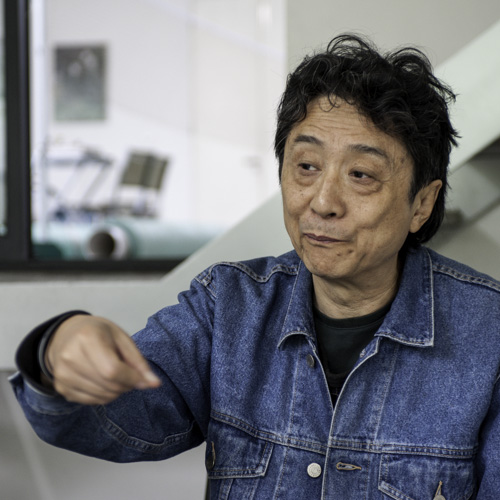
He Duolingh bears a disconcerting resemblance to Paul McCartney so it's a relief to see that his hair is not dyed, that there is variance of colour, all the way to grey, contained in its palette. Either that, or he's got a better hairdresser.

The resemblance isn't just personal: the work has an overall sugariness tempered with attempts at something harder. It has a smell of David Hamilton as well, an echo reinforced by the net strung across the gym-sized studio and a pile of sportswear in the corner. And the evident joy taken in conducting simultaneous interviews has a familiar, beatle-y ring to it.


Visiting He Duolingh's studio was a good introduction to the culture of the successful artist which seems to be thriving in China. He lives and works in a purpose-built enclave of artists' studios, constructed in an inward-looking circle. His studio is in a little side road, the tail on the Q, the superior studio with its own leisure facilities beyond the netball court.


In a way that was to become familiar, he started the interview waiting for every question to be asked then translated. Before long he was interrupting the translator or answering the question before it was translated.


Did he, like some would later, eventually break into broken English in frustration at the translation? Maybe - I don't remember, because there was something increasingly uncomfortable about the works around us - not the rather fay, wireframe bicycles and cellos, but those Hamilton-like canvases. Dodgy, I'd call them.


As a little after-thought, a dessert to his main course,  He took us to visit a neighbour in the enclave,  a young man about whom they all agreed he must have considerable backing from rich parents, given the cost of the studios, the quality of his materials, and the swankyness of his car. As for his work, this tribute, or fan-wall, or obsessor, to Avril Levigne doesn't seem that different to a million teenagers' walls. It's not a surprise to discover that we have no record of his name.


Next: Xiao Kegang

Moving Beyond: He Gong

In April 2012 I accompanied Janet Mckenzie Spens on a trip to China in order to interview and photograph painters in their studios. The expedition was the result of a chance meeting on a train between a Chinese poet and a young Cambridge graduate. It culminated in the show,  Moving Beyond, which opened at Summerhall in Edinburgh on July 31st and runs for 6 weeks.

The initial choice of artists were largely of an age which meant that, having first trained in their art, they were then sent to work in fields and factories, separated from family and friends, unable to pursue their artistic ambitions.

A change of attitude at the highest level saw a reversal of this.


He Gong was one of the first allowed to leave China in order to study in the West. He met us from the plane driving a white, long wheel-base Defender of which he is vastly proud, all spattered in premiership football club stickers.


He Gong loves to talk. There is a constant sense of subversion in his growling voice, a subversion which keeps sliding into humour, often self-deprecating, but usually with a sharp point. He is that rare person, an artist who listens to what other people have to say.

The university at which he teaches does not, in his opinion, provide enough accommodation for students; he has bought a couple of small apartment blocks next to his studio, so that he is always available to his students. The resulting atmosphere is akin to a mixture of miniature kingdom and amusement park.


He Gong's studio is far from the gob-smacking immenseness of many that we visited. Parked at one end is a replica of Che Guevara's motorbike which He Gong had intended to use on a re-creation of the famous ride. However, that plan had fallen at the first fence when he wasn't allowed to import it. He did still make the ride, albeit on a Yamaha.


In the way that it often seems to happen in China, it transpired that the hotel we were staying in (a modern, business man's hotel, catering to Chinese rather than foreigners, and thus having no coffee available in the mornings) was owned by He Gong's brother. A small banquet appeared at dinner time. He Gong's appetite is as enthusiastic as everything else in his makeup.


He's a charming man, warm and welcoming. When there, he told me that he often drives to Tibet with his students. I asked him about this again two days ago. It appears that I'll be joining him on the Tibet drive, either this Autumn or in the following spring. Watch this space.


Next: He Duoling...


Wednesday, 19 September 2012

Web Patrol


 The web is strung between a high brick wall and the plant you see later. Behind it curves a white wall, accounting for the light that falls so conveniently on the spider at the centre of his web.

He's too close to the wall for a head-on shot from this side. There is a ring of dead flies around him on the web, his larder laid out.
Moving in closer I'm my usual inept self with focus on the macro, always over-estimating my depth of field. Luckily, with the help of Lightroom (fab tool that it is), there are enough colours, shapes, and textures to keep the eye amused


A moment later, and he's off on patrol, heading up the top of the support rope, motoring along as if on a tight schedule. Perhaps he has to do an entire circuit of the web...


His destination is the flower head to which this side of the web is attached.  In the images  taken earlier there appears to be a big stash of web getting tangled up, so maybe he's stretched that out ...

There's certainly a few loose strands on that rope. I give you a spider.


Friday, 22 June 2012

Greek Victory

At the bottom of the street is the Greek Orthodox Cathedral of London. That makes Moscow Road, on which it sits, a cultural collection point for Greeks in London.

In 2004 Greece won the Euros, much to everyone's astonishment, not least their own. That night the celebrations filled the street, with dancing and shouting and music and fireworks and real joy.

People wrapped themselves in flags, the whole street turning blue and white. I was out there with an early Nikon DSLR, the D100, I think. (The exif datas has gone from this copy, and I'm not about to connect the archive.)

I took hundred of pictures, but this one seemed to sum it up. He was sitting on his girlfriend's shoulders (they took turns), the upward angle giving that slight sense of movement to the image; the blue of the flags has all but gone, yet still makes itself known, even under the sodium light; the noise has the same dramatic effect as grain; and, above all, he looks properly happy.

Who is he?

It doesn't matter, because all I have to do to make this picture complete is to give it a name, and it can only have one name: Greek Victory.

This evening, Greece plays Germany in the second Euro 2012 quarter-final. I don't think Moscow Road will be blocked tonight.

upside fucking down

The overriding stunner on the D4 is its high ISO performance.  In other words, it takes damned good pictures in very low light. This is great fun indoors, with people, but it becomes positively transformative outside with a macro lens. The usual problem with these is finding enough depth of field to make a picture in which the whole of the bug is in focus. With a high ISO and low noise, ramping up the numbers bring the focus under control.

As this is the big time of year for all things creepy crawly and flowery, I took the D4 and an old 105 macro out for a run the other day. The cow parsley alway offers a captive show, being apparently irresistible to any thing resembling an insect.

After a few minutes I came across this couple.


In my usual short-sighted way, it wasn't until I was checking the image for focus in the monitor that I noticed the couple-ness. In approaching the plant I brushed some grasses which, although not directly touching the cow parsley, did appear to have some kind of mechanical connection. The insects' ground moved beneath them. They ignored it, far too absorbed in what they were doing.


After a few of these transmitted wobbles, they became mildly pissed off, muttering about respecting an insect's privacy. They headed slowly towards the edge of the flowers as if preparing to take off and disappear, the last inhabitants left on this particular planet.


But I had misinterpreted their intention. There was still stuff to do, so they weren't about to leave their love nest. Rather than taking off from the edge, thy did that one thing that makes me want to be an insect: they walked over the edge and turned the floor into the ceiling, and the ceiling into the floor.


A moment later, they were back doing what they wanted to do, only this time hanging upside down from the underside of the cow parsley


Getting these pictures onto the computer,  I fired up Lightroom 4 and pulled the pictures in. The latest version has the controls layed out in a new way. It's the first time Adobe have moved away from the old wet, darkroom, analogy, and it's a triumph. Backlit images used to be hard to control. Not any more.


Looking at these, in this colour space, there's more that could be done, but I'll leave them like this for now. Anything you you think of that might improve the images, it can almost certainly be done, and easily.


It would be useful, but not essential, to know what these insects are.  It's not that I'm a bug freak, just that there's something frustrating about having a picture in which I can't put a name to the contents although there are occasions when having to make up a name serves the image better. I'll show one of those in the next post.


Saturday, 28 April 2012

D4med

So: the big excitement over here at PhotoBof Towers is the appearance of a Nikon D4. It's been here for a few days but a birthday intervened, so today is the first time of use. Examples might appear...remarks might materialise ...but mainly, buttons will be pressed, with equal measure of trepidation and enthusiasm. I can remember some of the reasons that convinced me to tell the Grey people that I wished take my place on the waiting list: new live view to make the tilt/shift easier to use, Full HD movie capability, a general improvement. But I cannot remember what tipped me. Today will tell whether I've been extravagant or wise.

Friday, 3 February 2012

Go!

St Martin's Lane - for a few days only - go see!


Monday, 23 January 2012

they must be on one

For some years the photographer's number one tool after the camera has been Photoshop. I've been using it for about 18 years. There's probably still more about it that I don't know than I do. Working in a design office, where there were graphic designers, product designers, and architects, there was something new, some little tweak or alternative route that I discovered every day. It is an amazing tool.

That amazingness leads to some unfortunate perceptions. To say that an image has been Photoshopped tends to be derogatory, but also tends to display the ignorance of whoever says it. Pretty much every professionally made image will have been through Photoshop (or perhaps Lightroom, its equally amazing but leaner, younger sibling) even if only to leave a printable file: RAW files, the basic building blocks of the photographer's workings, are not viewable or printable in themselves.

There is no doubt that as many bad things have been done with Photoshop as good things; but we don't blame Word for bad writing ("O-o-oh! It's been Worded!") so why blame Photoshop for the crap produced by bad photographers and designers?

Sadly, the industry itself is partly to blame. This morning's email produced a good example. A company called onOne Software has been buying up good software companies and turning their product to shit. I hear from them because I have used the Genuine Fractals plugin for years. When I last checked it was the best image enlargement software easily available. For no good reason, onOne have renamed it Perfect Resize; this has obviously had such a negative effect that they now have to say (formally Genuine Fractals) every time it's mentioned, a good indicator of their idiocy.

Of all the new techniques, the one which can produce the most hideous results is HDR, the trick of making an image look as if all the dark bits and all the light bits are equally well exposed, something which tends to be impossible in reality. This is what makes those vile pictures with over-blue seas and over-red mountains. Even in expert hands it's ugly, but in the mits of an amateur it's positively shocking.

onOne have a plugin dedicated to this, and their video shows how horrible it is (although they seem to think it's pretty.)

But it wasn't this which turned on the light for me today - it was the blurb for their Perfect Layers software which rang the bell that turned the switch: "...the fast, easy, and affordable way to create layered files outside of Photoshop."

Has nobody at onOne seen the VW Golf ads, "Just like a Golf"?

Clunk.

Tuesday, 10 January 2012

Correction

On closer examination, the prints at Leibowitz's show have remarkably little pixel mangling, particularly the point-and-shoot shots. Others, such as Elvis's bike, appropriately have no pixels, only detail. Water, in all forms, seems to respond well if the pixels are left alone. I've been banging away at this for some time now, so it's a relief to see that others feel the same.

This shows a 100% detail of the solo picture currently on my site, where the phenomenon of water droplets painting on the sensor with white light is well demonstrated. Perhaps some see it as a grey mess, but this is what water looks like; it's not milk, and it's not glass. Back to Sid later.


back to the pixels

I remember discovering grain. Obviously, I was no pioneer or scientist, but in my world there had been, up until then, photographs or photographs which looked a bit blurred. I started processing and printing before I was ten and had a darkroom by fourteen, so the discovery of grain must have come by the age of nine years: I've always found it difficult to start something new without understanding something of how it works, and film works with grain.

The beauty of the way in which it tended to be used was that it appeared to absorb subject and object into the same space - somehow, a grainy picture is more accessible, more transparent than one in which the grain is invisible. This worked well for hard subjects. The word most often used is gritty, but it would seem likely that this usage arose from the coincident similarity to the the word grainy.

It's hard to tell how much of this attitude is learned and how much came unbidden. There is of course a strong pragmatic reason for visible grain: the faster the film, the more pronounced the grain. Shooting difficult, fleeting subjects often means low light, and low light means high speed (or flash, but that's for another day.) It doesn't take long before the mind automatically applies the equation grainy picture = interesting subject - useless as a shooting equation, but useful for interpretation.

This is not an attitude generally applied to digital imagery. It's as if the whole arena is in the hands of photographic puritan dullards. They abhor visible pixels, hence the dismissive description, noise. But the pixel is the basic brick of the photograph, and to be embarrassed by its presence is like a painter being embarrassed by his brush strokes.

It's therefore interesting to visit Annie Leibowitz's current show, Pilgrimage, at Hamilton's Gallery. Many of the pictures were taken with a point-and-shoot. I asked the slime-ball in residence whether Leibowitz had printed them herself. "No" he sneered, "They're all printed by master-printer David Adamson." I asked whether he was primarily a wet print master or digital. "Obviously, wet originally, but they do everything now."

Wrong, slime-ball. Adamson moved directly from lithography to digital. Such a lack of interest in an important part of the process characterises much of this end of the photographic market. It's hard to tell from a first look at the prints how much noise reduction and sharpening (both of which destroy pixels) has been used, but I suspect that even the master printer is toeing the line of using "at least some sharpening and noise reduction."

I am about to go there again to examine further. Meanwhile, this is shot which I believe benefits from being shown entirely without the two pixel manglers. This is, of course a reduced version, so has some inevitable mangling. More (or less) detail later.


Tuesday, 13 September 2011

Crappy Snaps

It's a splendid thing that kids have embraced film for stills. They love it. And the trendiness of the medium ensures that one more generation will be properly aware of the physicality of photography.

One inevitable drawback at the beginning of any photographer's use of film, the learning days, is that one or several frames on each roll may be blank or fogged. When there was only film, all the processing shops, particularly the high street ones, knew this, and charged per print. If you had a blank frame, you didn't pay for a print of it (although some unscrupulous operations would try this one on).

However, if a kid takes the 120 roll from his Diana into Snappy Snaps, about the only high street print shop left, he will be told that he has to pay for a print of every frame, whether it's been exposed or not. Even more curiously, if the film turns out to be completely blank (forgotten to take the lens cap off?) they will generously only charge just over 2 quid. If it has exposed images on it, the developing alone will cost around 9 quid. The cost to them has been the same, properly exposed or not. If you want prints (see above) it's around 15 quid.

All this will do is tell the kids that they've unwittingly taken up a very expensive hobby, and send them back to their point-and-shoot digitals. It's as if Crappy Snaps want to look cool but can't be bothered to do the work associated with it.

Monday, 12 September 2011

New Prune

Going for a walk at the Hermitage is synonymous with exposing a frame or two, but this time the Nikon was spitting incomprehensible error numbers at me and the Fuji's battery was flat; its charger has not yet found a safe place to travel and so had been left behind.

I walked without a camera and saw a hundred and one shots I would have liked to take. The time of year is fast approaching when it's unwise to be without a camera at any moment: the sun sinks lower, giving off warmer colour and more interesting shadows, the trees put on their gold and bronze while opening their curtains. The landscape changes shape and colour, the smells change.

There was no frustration in the process, rather, a calm excitement. Reminders of unfinished business (anything to do with landscape is always unfinished) were everywhere. Some could stay unfinished (I no longer think that that an extended panorama, electronic or rolled-up-print, of the brook would be of any interest to either myself or anyone else) and some could be happily welcomed back (reflections of sunlight off the surface into dark corners come back into their own as the sun dips and glows).

Above all, it was an almost-forgotten pleasure just to look. Capture, in its usual form, was not there to halt the process. I do retain two of the potential images in my mind's gallery. This will become a problem at some future moment when the image continues to burn brightly long after I have forgotten that I never actually took the picture. I will search my hard drives high and low for it and in the process will accidentally discover taken images which I had forgotten. These will either be rescued from the darkness of the archive or will lead to new photographic forays. Whichever, the act of not taking photographs on one day will certainly lead to more and better on another. It's like pruning, cutting back growth in order to encourage more.

I shall take more pruning walks in the future.

Tuesday, 19 April 2011

old chestnuts in spring?

In the park today I came across these two objects, lying in the middle of the path, with no sign of an owner.


They had prompted a series of super-fast movies in my head, detailing alternative possibilities for the story connected to the shoe and the sock. I noticed that others appeared to be doing the same thing and so began to photograph their reactions.


Not everyone noticed them.


Then I stopped, because the thought that had entered my head seemed more pressing than making the pictures.

What if it had been me who put them there?

It's a very similar question to the one that landscape photographers ask themselves: if I move that branch out of the way, am I somehow cheating?

And then I became cross with myself, because it seemed as if I was making the same mistake as the viewer who says "Ah! But you've used Photoshop on that" as if there were some contract that comes with every camera, stipulating that all pictures made with the machinery must be a 100% honest and accurate record of what was there.

I suspect that, if I had put the shoe and sock there, I would have felt a duty to show deliberately some kind of knowingness in the images. Photographers like Gregory Crewdson have made careers out of single questions such as this, questions which non-photographers regard with deep suspicion and at which photographers groan inwardly. It seems a simple enough question but it isn't.

Saturday, 27 November 2010

get back

Going to a heritage visitor attraction in the UK is visiting a museum, no matter what the owners and managers might say about living history. There is no real connection between the presented heritage of the past and the evolving heritage of the present. They are separate worlds.
At first glance this seems also to be the case in China but it doesn't take long to realise that there's a connection here which is lacking in the West. Although every town and city appears to have its own version of Chinatown, as if it were San Francisco or Soho, it soon becomes clear that the front melds seamlessly into the back. Once more, the old rubs shoulders with the new. 


In Zhu Jiajiao cranes tower behind preserved roofscapes while an old man playing an Erhu on a stone bridge sits on a soft laptop-case as a cushion.


On the narrow streets beside the canals, thronged by Chinese tourists, live chickens change hands for the daily meal.


This is one of the many places where the damage created by the Cultural Revolution is being repaired in front of our eyes. But the living heritage is somewhat different. The New China is rising in front of you everywhere, several revolutions happening simultaneously on every side, but predominantly the industrial one with its insatiable demand for more and better communications.


I've rarely seen a better example of form following function to create beauty than the soaring highway interchanges. They can be sen better in a video taken from the new bullet train, which I'll post later in edited form. Of course, many of these skyways have been created at the expense of the destruction of old agricultural villages. Inhabitants are moved to new high rises built nearby. Is their life improved or just changed? Too many told me that it was improved to credit the idea that this is just propaganda.